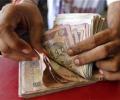
The rupee hit a near 10-month high as an alliance led by pro-reform and business friendly Hindu nationalist Narendra was on course for an absolute majority.

Rupee ends day stronger against the dollar.

Gold prices recovered by Rs 100 to trade at Rs 27,200 per 10 gm at the bullion market.

Gold prices on Monday drifted by Rs 105 to trade at a three-week low of Rs 27,225 per ten grams.

The government was also faced with problems on its balance of payments. It took steps to conserve declining foreign exchange reserves, and began to regulate the production, supply and distribution of gold. It banned forward trading in the yellow metal in November 1962, and introduced gold bonds as well, reveals the RBI's annual report for the year ending June 1963.

The rupee tumbled 19 paise to close at a fresh lifetime low of 77.93 against the US dollar on Friday as rising crude oil prices and unabated foreign capital outflows soured sentiment. A sell-off in equity markets and stronger greenback overseas also weighed on the domestic unit, forex traders said. At the interbank foreign exchange market, the local currency opened at 77.81 and witnessed an intra-day high of 77.79 and a low of 77.93 against the US dollar.

Unabated buying by domestic institutional investors and wholesale price inflation falling to 2.60 per cent in September, helped both the key indices to scale new highs.

The new series claims GDP grew at seven per cent between April and June 2015, while gross value added (GVA) grew at 7.1 per cent.

The rupee depreciated 40 paise to an all-time low of 81.93 against the US dollar in early trade on Wednesday as the strengthening of the American currency and risk-averse sentiment among investors weighed on the local unit. Moreover, a negative trend in domestic equities and significant foreign fund outflows sapped investor appetite, forex traders said. At the interbank foreign exchange, the rupee opened at 81.90 against the greenback, then fell to 81.93, registering a fall of 40 paise over its previous closing.

The dollar's weakness against some currencies overseas limited the rupee's fall.

Financial, capital goods, IT, power and oil and gas sector stocks hogged the limelight, helped indices to reclaim their key level.

The country's foreign exchange reserves surged to $576.98 billion as on March 31, 2021 from $544.69 billion at September-end last year, an RBI report said. Foreign currency assets (FCA), a major component of the overall reserves, increased to $536.693 billion as at March-end 2021 from $502.162 billion, the report noted. On balance of payments basis (excluding valuation changes), foreign exchange reserves increased by $83.9 billion during April-December 2020 as compared with $40.7 billion in the year-ago period, it said.

The Reserve Bank on Thursday said it has put in place contingency plans to infuse liquidity into the system to deal with any possible volatility in markets on Friday in view of the election results.

The rupee depreciated 44 paise and slipped below the 81-mark against the US dollar for the first time in early trade on Friday, weighed down by the strong american currency and risk-off sentiment among investors. Forex traders said escalation of geopolitical risk in Ukraine and rate hikes by the US Fed and Bank of England in a bid to contain inflation sapped risk appetite. Further, the strength of the American currency in the overseas market, a negative trend in domestic equities, and risk-off moods amid escalation of geopolitical risk in Ukraine weighed on the local unit.
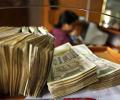
Bearish dollar overseas also supported the rupee

In Delhi, gold of 99.9 and 99.5 per cent purity zoomed up by Rs 650 each to Rs 27,470 and Rs 27,270 per 10 grams respectively.

The union government is expected to cut two per cent import duty in gold in the forthcoming budget, as local jewellers run out of inventory, a leading US brokerage said.

The Indian rupee, which has depreciated 1.1 per cent so far in August, is expected to decline further on the back of a strengthening US dollar and a weakening Chinese yuan, according to a Business Standard poll of analysts. The Indian rupee hit an all-time low recently, closing at 83.15 per dollar. Five of the 10 respondents said the Indian currency might touch 83.5 per dollar in August itself, while others said the worst could be over.

In dull trade, the rupee on Monday ended a mere two paise lower at 60.20 against the US dollar on weak local equities and imported-driven demand for the American currency.

In forward market, premium for dollar declined in view of mild receivings from exporters.
The rupee depreciated by 37 paise to close at 79.62 against the US dollar on Thursday despite sustained foreign capital inflows and a positive trend in equities. At the interbank foreign exchange market, the local currency opened at 79.22 and saw an intra-day high of 79.22 and a low of 79.94 against the American currency. It finally ended at 79.62, down 37 paise over its previous close of 79.25.

The rupee snapped its two-day winning run against the dollar.

Benchmark interest rate hiked by 50 basis points to 3-year high at 5.90 per cent. Economic growth projection for FY23 cut to 7% from 7.2% estimated in August. GDP expected to grow at 6.3% in September quarter, 4.6% each in December and March quarters.

'She delivers on promises, especially on security issues which is a core concern for India.'
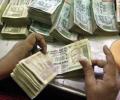
The RBI fixed the reference rate for the dollar at 65.2525 and for the euro at 72.1954.

The 50-stock NSE barometer Nifty finished 14.75 points, or 0.14 per cent, down at 10,382.70 after shuttling between 10,340.65 and 10,393.15.

gold prices fell by Rs 210 to Rs 26,600 per 10 grams.

India's projected economic growth for 2022 has been downgraded by over two per cent to 4.6% by the United Nations, a decrease attributed to the ongoing war in Ukraine, with New Delhi expected to face restraints on energy access and prices, reflexes from trade sanctions, food inflation, tightening policies and financial instability, according to a UN report released on Thursday. The UN Conference on Trade and Development (UNCTAD) report downgraded its global economic growth projection for 2022 to 2.6 per cent from 3.6 per cent due to shocks from the Ukraine war and changes in macroeconomic policies that put developing countries particularly at risk. The report said while Russia will experience a deep recession this year, significant slowdowns in growth are expected in parts of Western Europe and Central, South and South-East Asia.

Silver also fell for the third day.
Fresh demand for the US currency from importers and banks alongside sustained capital outflows by foreign funds weighed on the local unit

Silver also recorded a sharp fall of Rs 1,000 to Rs 37,400 per kg.

A lower opening at the domestic equity market and the dollar's rise against other major currencies overseas also put pressure on the rupee, dealers said.
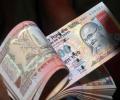
Sustained capital inflows supporting the rupee sentiment, a forex dealer said.

Ongoing trade-war rhetoric between the US and China added some nervousness on the trading front coupled with extremely bullish dollar sentiment overseas.

The Indian rupee resumed sharply lower at 66.65 per dollar against last Friday's level of 66.48.

The rupee continued to rule firm against the dollar for the second consecutive day.

Consistent capital inflows and a recovery in local equities helped the local unit to trim initial losses
Dollar weakness was a major contributor to the rupee recovery as the skittish investors continued to lighten their long positions.
The rupee has lost 37 paise or 0.55 per cent in two days.

Weak equity markets too hit rupee sentiment
